About
artist Bio
Steven Fox is an Odawa artist of Potawatomi descent based in Gaageigawaan (Kagawong) on Odawa Mniss (Manitoulin Island, Ontario).
His multidisciplinary practice spans sculpture, carving, design, digital media, projection, and mixed media, exploring the relationships between material, process, and observation. While wood is a primary medium, his work extends across disciplines, drawing on whatever materials best serve the ideas being explored.
Raised within a family deeply connected to Anishinaabe arts and culture, Fox developed an early appreciation for both creative practice and traditional knowledge. His formal education in the sciences provided a complementary framework of experimentation, critical inquiry, and observation that continues to inform his studio practice.
Over the past three decades, he has worked extensively with First Nations organizations in project management, research, and community development while maintaining an active studio practice. His work has been exhibited in galleries and public exhibitions and continues to evolve through material experimentation, contemporary Indigenous design, and public art.
Steven Fox lives and works in Gaageigawaan, where Odemin Arts serves as both his studio and ongoing site of research, experimentation, and creation.
Working across sculpture, carving, design, installation, projection, and mixed media, the practice is guided by observation, material, and process rather than adherence to a single medium or discipline. Wood is often the starting point, but each project determines its own direction.
Living and working within a maple forest on Manitoulin Island, the surrounding landscape informs both the materials and the methodology. Fire, water, air, light, pigment, and natural growth patterns become collaborators in the making of the work. Rather than imposing predetermined outcomes, the process encourages dialogue with the material, allowing form to emerge through experimentation, observation, and refinement.
The practice draws equally from lived Anishinaabe experience and scientific inquiry. These are not treated as opposing ways of understanding, but as complementary approaches grounded in careful observation, curiosity, and respect for the natural world. Traditional knowledge provides cultural grounding while experimentation, iteration, and material investigation shape the work in the studio.
Whether creating hand-carved paddles, sculptural vessels, large-scale relief carvings, public art, or works incorporating light and projection, the intention remains the same: to produce contemporary work that is rooted in place, informed by process, and open to discovery.
artists Statement
My practice begins with observation. Whether working in wood, light, pigment, projection, or digital design, I approach each material with curiosity rather than certainty. The work develops through experimentation, allowing the characteristics of the material to influence the outcome as much as my own intentions. there is no real plan, no goal.
Growing up surrounded by Anishinaabe culture, I did not experience it as something separate from everyday life. It was simply the environment in which I was raised. At the same time, my education in the sciences taught me another way of understanding the world—through observation, questioning, experimentation, and evidence. Rather than existing in opposition, these two ways of knowing have become complementary within my practice.
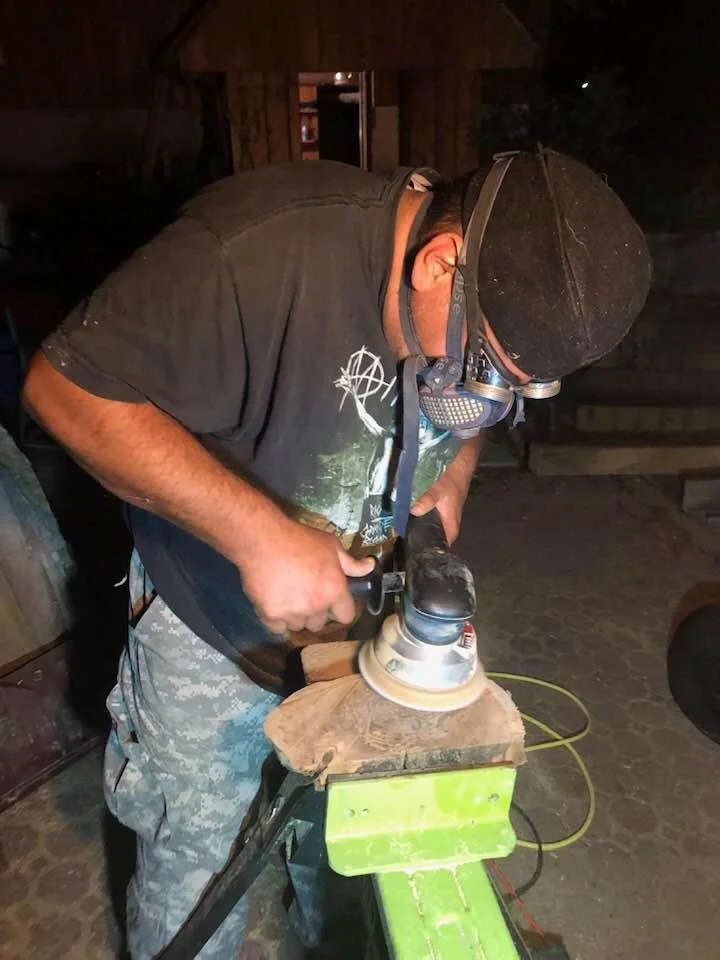
I am interested in process as a form of discovery. Fire, air, water, gravity, light, and time are not simply tools but active participants in the making of the work. Controlled burning, carving, machining, abrasion, pressure washing, and finishing reveal structures that are often hidden beneath the surface. Much of the work emerges through responding to what the material reveals rather than imposing a predetermined image.
Knowledge does not exist only in books or instruction. It also resides in lived experience, careful observation, repetition, failure, and making. Every experiment contributes to the next question. Every finished work becomes part of an ongoing investigation rather than a final answer.
While my work is informed by Anishinaabe ways of understanding place and relationship, it does not seek to illustrate stories or reproduce historical forms. Instead, I am interested in creating contemporary work that grows from the same values of attentiveness, respect for materials, and continuous learning.
For me, there is no meaningful boundary between art and science. Both begin by asking questions. Both require humility in the face of uncertainty. Both demand careful observation and a willingness to change direction when the evidence suggests a better path.
The studio is where those conversations take place.